
Robotics & embedded systems
Robotise a workstation, from task analysis to production launch.
6-axis robotic arms, complete cells, grippers and end effectors, conveyors, sensors, vision, automation and control software. We always start from the actual workstation.
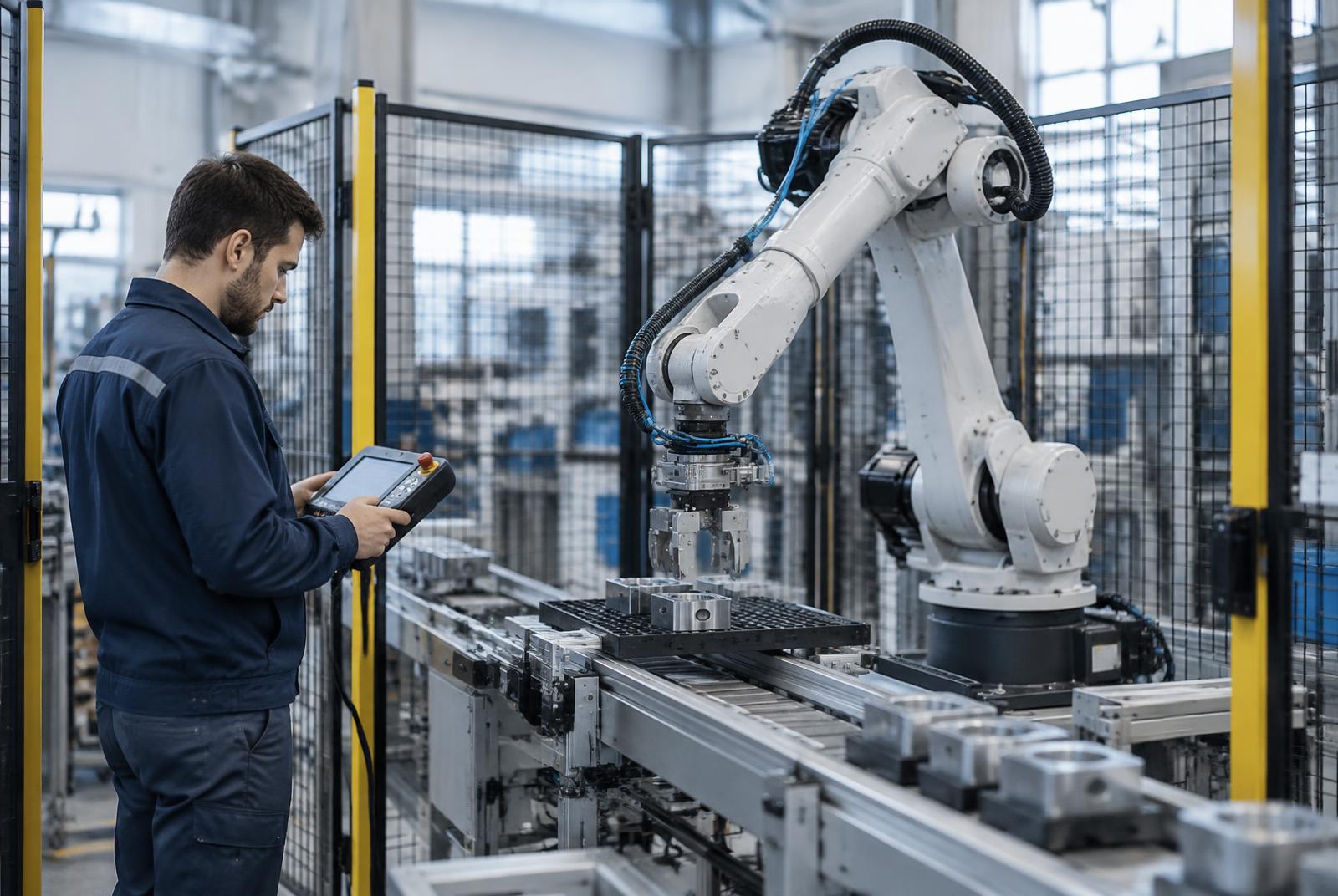
What we hear in a first meeting
- “We can no longer recruit for this palletising position.”
- “Our operators repeat the same motion 3,000 times a day.”
- “We want a robot, but we don't know if our throughput justifies it.”
What we do, in practice
6-axis robotic arms
Robot selection based on payload, reach, cycle time and environment.
Robotic cells
Layout, guarding, light curtains, risk assessment.
Grippers, clamps, end effectors
Suction cups, mechanical or electric grippers, custom tools designed for the part.
Conveyors and peripherals
Feeding, evacuation, indexing, turntables.
Sensors and vision
Detection, part localisation, camera-based quality control.
Automation and control
Robot and PLC programming, HMI, data reporting.
Technical expertise
What a cell includes, and how we deliver it
Robot and peripherals
- —6-axis industrial robots and cobots, based on payload, reach and cycle time
- —Grippers, suction cups, clamps, specific tools
- —Conveyors, turntables, magazines, indexing
- —Vision for robot guidance and quality control
Automation and control
- —PLCs (Siemens, Schneider…), HMI, industrial PCs
- —Robot programming: trajectories, conveyor tracking, PLC communication
- —Cycle optimisation, error handling, diagnostics
- —Data reporting to supervision or ERP
Safety and compliance
- —Risk assessment from the design stage
- —Guarding, light curtains, laser scanners
- —Compliance with the Machinery Directive 2006/42/EC
- —Technical file and CE marking of the cell
Project stages
- —Workstation analysis: part, cycle time, quality, ergonomics, available space
- —3D design and simulation of the cell
- —Manufacturing, wiring, assembly
- —On-site commissioning, acceptance
- —Training of operators and maintenance staff
- —Maintenance and program updates
Sectors of application
IndustryFood & beverageLogisticsPlasticsMechanical engineeringTransportA cell, not just a robot
The robot is just one element. The value is in the integration.
Gripping, conveying, safety, PLC, HMI, data reporting: it's the whole system that holds the cycle rate, not the arm alone.
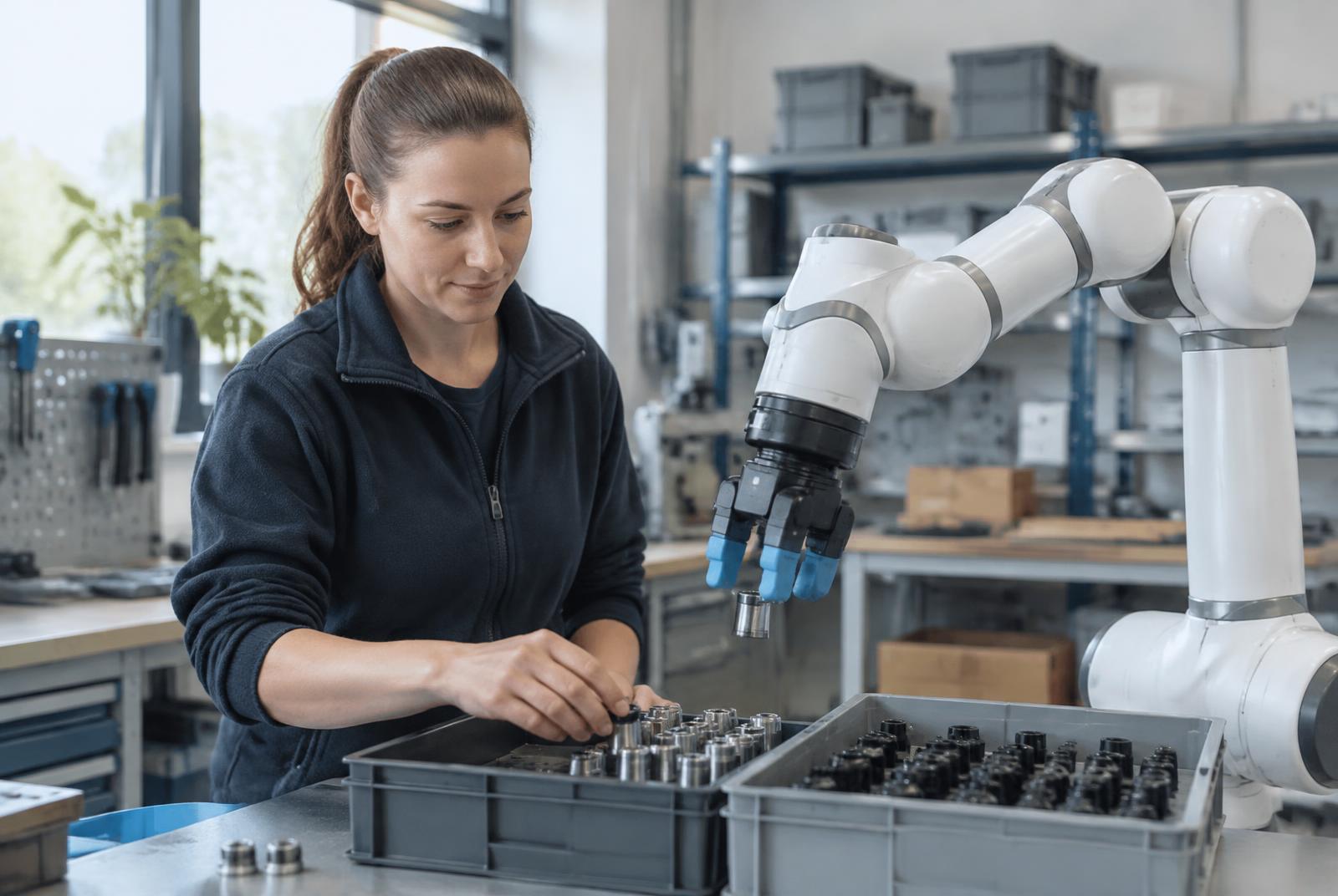
Cobotics: start small, then expand
For SMEs getting started: a first assisted workstation, measurable and reversible. Simple programming, handed back to your teams, then expanded station by station.
Approach
From observed workstation to robot in production
A successful robotics project is mostly decided before the first line of code. We spend time at the workstation, with the operators, before proposing a robot.
- Step 1
Workstation analysis
Task, cycle rate, part, weight, environment, operator constraints. We film and measure.
- Step 2
Feasibility
Cycle time estimation, gripping trials if needed, initial costing.
- Step 3
Robot and end-effector selection
Robot, payload, reach, gripper type. Tool design if necessary.
- Step 4
Cell and safety
Layout, guarding, risk assessment, integration into existing flows.
- Step 5
Programming and commissioning
Trajectories, automation, HMI, trials in the workshop then on site.
- Step 6
Training and maintenance
Operators and maintenance staff trained; ongoing support and evolutions.
Use cases
Situations we know how to handle
Palletising and depalletising
Cartons, bags or crates: palletising patterns configurable by the operator, reference change without intervention.
Pick & place and packaging
Picking from a conveyor, boxing or tray packing.
Machine tending
Loading and unloading machine tools or presses.
Assembly and screwdriving
Repetitive, consistently precise motions, with torque traceability.
Inspection and sorting
Vision to sort, reject non-conforming parts, measure.
Welding and end of line
Welding robot on repetitive parts, boxing and automated tests at the end of the line.
Technologies and ecosystem
- ABB
- FANUC
- KUKA
- Yaskawa
- Stäubli
- Universal Robots
- Siemens
- Schneider Electric
- 2D/3D Vision
- Light curtains
- Vacuum gripping
- HMI
Indicative list. No official partnership is implied.
Way of working
- Feasibility study
- Workstation analysis, gripping trials if needed, cycle time estimate.
- Turnkey project
- Design, integration, commissioning, training.
- Maintenance
- Follow-up contract, program updates, wear parts.
What cycle time is needed to justify a robot?
It depends on the strain of the task, the cost of the position and its stability. The feasibility study gives a quantified answer.
Industrial robot or cobot?
A cobot suits low payloads and moderate cycle times with shared space. Beyond that, a robot in a cell is more appropriate.
Who handles the safety of the cell?
Risk assessment and protective devices are part of the project from the design stage.
A workstation to robotise?
Send a video of the workstation and a few figures: part, cycle time, weight. We'll tell you if it's feasible.
Describe your situation
No specification document needed. A few lines are enough for us to know whether we can help.